How to Fix a Wobbly Kitchen Faucet Handle (5 Safe Steps)
Note: If you buy through links on our site, we may earn an affiliate commission at no extra cost to you. How this works.
- Turn off the hot and cold supply valves first
- Find the set screw under the handle or cap
- Tighten the set screw with the correct hex key
- Tighten the retainer ring or dome cap underneath
- Replace a worn cartridge or stripped stem if wobble returns
Why does a kitchen faucet handle get wobbly?
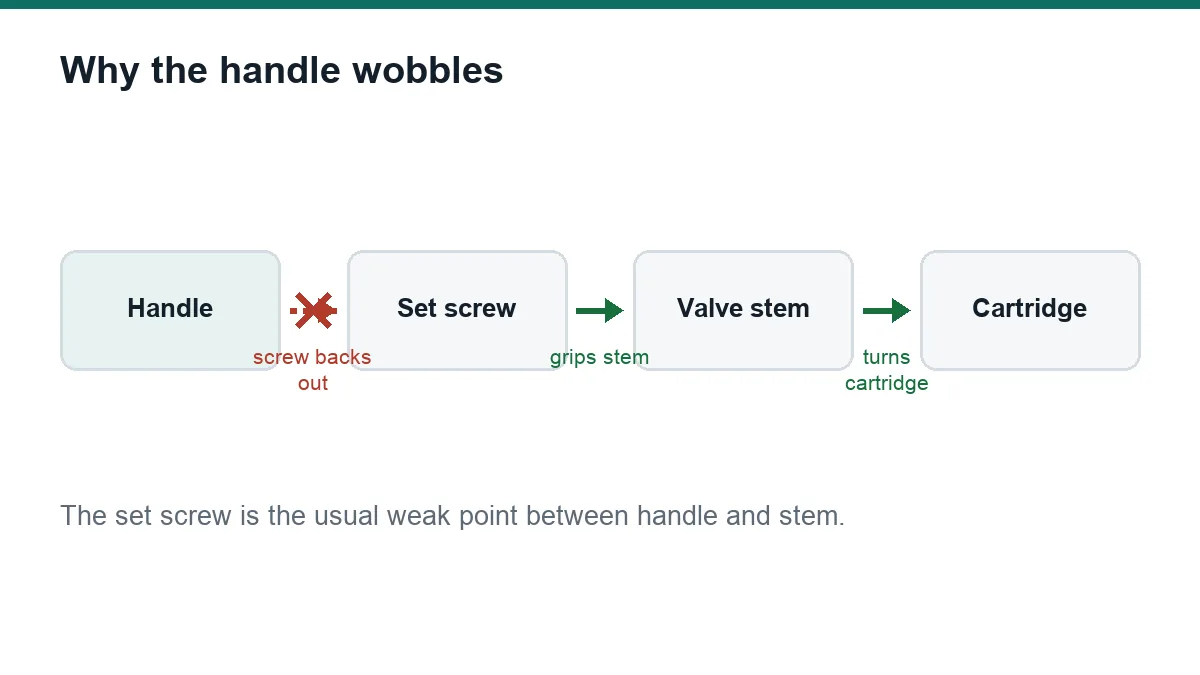
Most single handle kitchen faucets hold the handle on with one small set screw. The screw presses against the valve stem that sticks up from the cartridge. Every time you lift and swing the handle, that screw takes a little strain.
Over months of daily use, the screw backs out a fraction of a turn. The handle then rocks on the stem, even though the faucet still works. That is the wobble you feel.
Other causes are less common:
- Loose retainer ring or bonnet nut: the ring under the handle that holds the cartridge in place has loosened.
- Worn stem splines: the grooved tip of the stem is rounded off, so the handle cannot grip.
- Stripped set screw: the hex socket in the screw is rounded and will not tighten.
- Loose faucet base: the whole faucet moves on the sink, not just the handle.
Check which part moves before you start. If the full faucet body rocks, the mounting nut under the sink is the problem, not the handle.
What you need
- Hex key set: sizes vary by brand. Kohler lists a 3/32 inch or 2.5 mm hex wrench for one of its kitchen faucets.
- Small flat screwdriver: to pop off a decorative cap or plug that hides the screw.
- Adjustable wrench: for the retainer ring or dome cap under the handle.
- Soft cloth or tape: to wrap wrench jaws so they do not scratch the finish.
- Your faucet’s model number: usually in the installation guide or on a tag under the sink, for ordering parts.
- A towel in the sink: so a tiny screw cannot fall down the drain.
Safety note: turn off both supply valves under the sink before you remove anything. Pfister tells owners to shut the angle stops before any handle repair. Opening the faucet afterward lets out any pressure left in the line.
How to fix a wobbly kitchen faucet handle step by step
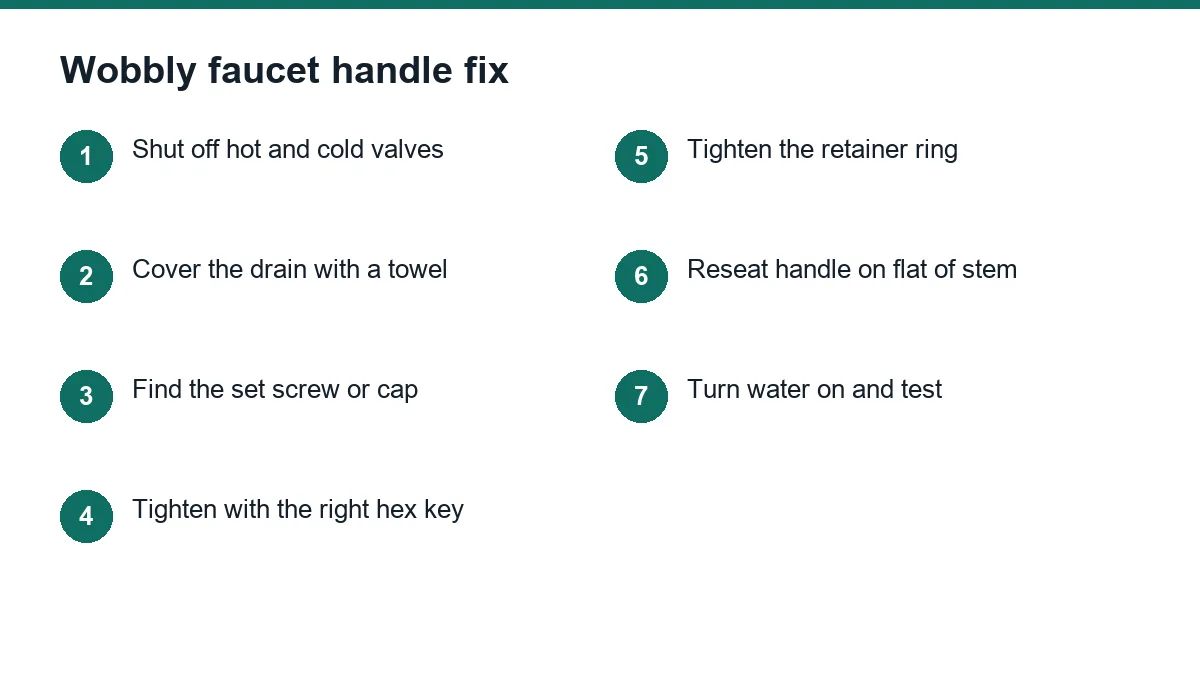
Step 1: Turn off the water
Close the hot and cold shutoff valves under the sink by turning them clockwise. Lift the faucet handle to drain any water left in the spout. Put a towel over the drain.
Step 2: Find the set screw
On most single handle faucets the set screw sits on the underside or back of the handle. Some models hide it behind a small cap or plug. Pry the cap off gently with a flat screwdriver.
If you cannot see any screw, check the installation guide for your model. A few faucets use a screw under the top cap instead.
Step 3: Tighten the set screw
Try hex keys until one fits snugly with no play. Kohler’s steps for one model say to rotate the handle to the on position first, then turn the set screw clockwise.
Tighten until firm, then stop. A small hex screw strips easily if you force it.
Step 4: Check the retainer ring if it still rocks
If the handle still moves, loosen the set screw and lift the handle off. Pfister’s guide shows a dome cap and a retainer ring under the handle. Tighten the ring clockwise with a wrench, then refit the cap and handle.
Step 5: Reseat the handle and test
Push the handle fully down onto the stem. If the stem has a flat side, line the set screw up with that flat face. Tighten the screw, refit the cap, open the supply valves and test hot, cold and off.
Still not working? What to check next
If the handle loosens again within days, a part is worn rather than loose. Look at these in order.
- The set screw: if the hex socket is rounded, replace the screw. Many faucet makers send small parts through their support lines.
- The stem splines: if the grooves on the stem are smooth, the cartridge needs replacing.
- The cartridge: a handle that drifts, shuts itself off or feels gritty often points to a worn cartridge.
- The handle itself: a cracked handle body cannot hold the screw tight. Order a matching handle by model number.
Replacing a cartridge means shutting off the water, removing the retainer and pulling the old cartridge straight out. Take the old one to the store or match it by part number. Do not over-tighten the new one, because that can crack it.
Call a plumber if the shutoff valves will not close or the faucet leaks under the sink. Other quick home repairs are listed in the kitchen fixes help hub.
Common mistakes to avoid
- Skipping the water shutoff: removing a handle or retainer with the supply on can spray water across the kitchen.
- Using the wrong hex key: a key that is slightly small rounds out the screw socket fast.
- Over-tightening: too much force can strip the screw, crack a plastic handle or damage the cartridge.
- Losing the tiny screw: always cover the drain before you start.
- Gripping chrome with bare wrench jaws: wrap the jaws in cloth or tape to protect the finish.
- Ignoring a loose base: if the whole faucet moves, tighten the mounting nut under the sink instead.
A wobbly handle is often one of several small fixes around the kitchen. Loose doors and drawers have similar quick fixes in our guides on how to fix a loose cabinet hinge and how to fix a sticky drawer slide.
When should you replace the whole faucet?
Most wobbly handles never need a new faucet. A set screw, retainer ring or cartridge solves nearly every case.
Think about a full replacement when parts are no longer sold for your model. It also makes sense if the body is corroded, the spout leaks at the base, or several parts have failed at once.
Key takeaway: tighten the set screw first, check the retainer ring second, and replace the cartridge only when the stem or screw is worn.
Products for this job
Related products on Amazon. We have not tested these ourselves; check the specs and the reviews on Amazon before you buy.
 TEKTON Ball End Hex and Star L-Key SetCheck price on Amazon
 WD-40 Specialist Silicone LubricantCheck price on Amazon
 Blum Compact BLUMOTION Soft-Close Face Frame HingeCheck price on Amazon
Frequently Asked Questions
What size Allen wrench fits a kitchen faucet handle?
It depends on the brand and model, so check the installation guide first. Common sizes are small inch sizes such as 3/32 or 7/64, and some faucets use metric keys like 2.5 mm, so a full set saves guesswork.
Can I fix a wobbly faucet handle without turning off the water?
Tightening a set screw alone does not open the water path, so some people skip the shutoff. It is still safer to close the valves, because a loose handle can lift off and expose the cartridge while you work.
Why does my faucet handle keep coming loose?
A handle that loosens again and again usually has a worn screw, smooth stem splines or a set screw sitting on the wrong face of the stem. Reseat the handle so the screw meets the flat side, or replace the worn part.
Is a wobbly faucet handle a sign of a leak?
Not by itself, because the wobble is usually just a loose screw. If you also see drips from the spout or water under the sink, the cartridge or seals may be worn and need replacing.