Chair Too Low for Desk? How to Fix Your Ergonomics (7 Steps)
Note: If you buy through links on our site, we may earn an affiliate commission at no extra cost to you. How this works.
- Raise the seat until elbows meet desk height
- Add a footrest if your feet leave the floor
- Lower or remove armrests that hit the desk
- Fit a keyboard tray if the desk stays high
- Replace a cylinder that will not hold height
Why is a chair too low for the desk a problem?
When the seat is too low, the desk sits near your chest. You lift your shoulders and bend your wrists up to reach the keyboard. Over a workday that strains the neck, shoulders and forearms.
OSHA notes that a desk too high or too low can cause awkward postures. Examples are raised shoulders and extended arms. A low seat can also push your knees above your hips, which loads the lower back.
If your back already aches, our guide on why an ergonomic chair hurts your back covers other causes.
What is the right chair height for a desk?
Your chair height is right when two things are true at once:
- Arms: with shoulders relaxed, your elbows bend at about a right angle and your forearms rest level with the keyboard.
- Legs: OSHA says your whole sole should rest on the floor. The back of the knee should sit slightly higher than the seat.
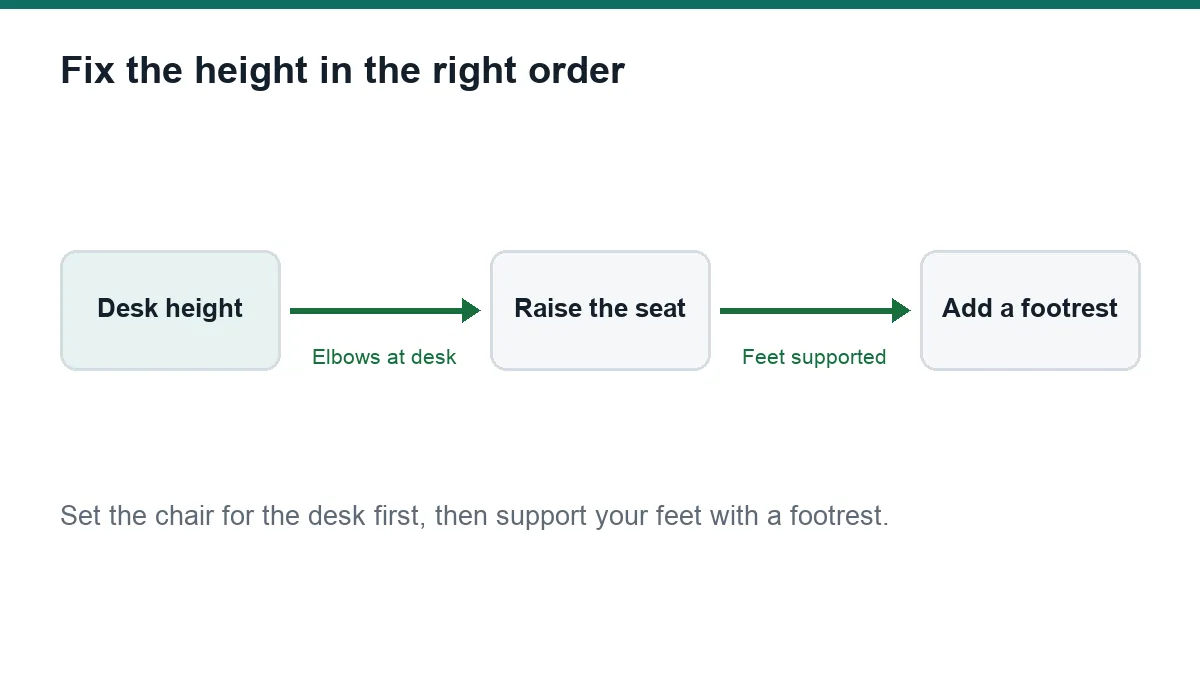
If you cannot meet both, set the chair for your arms first. If the desk cannot be lowered, OSHA advises raising the chair and using a footrest.
Key takeaway: match the chair to the desk, then match your feet to the chair.
What you need
- Your chair’s manual: it shows which lever controls height and its height range.
- A footrest: a stable, flat one, or a sturdy box as a stopgap.
- A tape measure: to check desk height and leg room.
- A keyboard tray (optional): for desks that are too high to fix any other way.
Safety note: do not stack books or loose cushions to raise yourself, since they can slip. Never take apart or heat the gas cylinder, which is under pressure. Follow the maker’s instructions for any part swap.
How do you fix a chair that is too low for the desk?
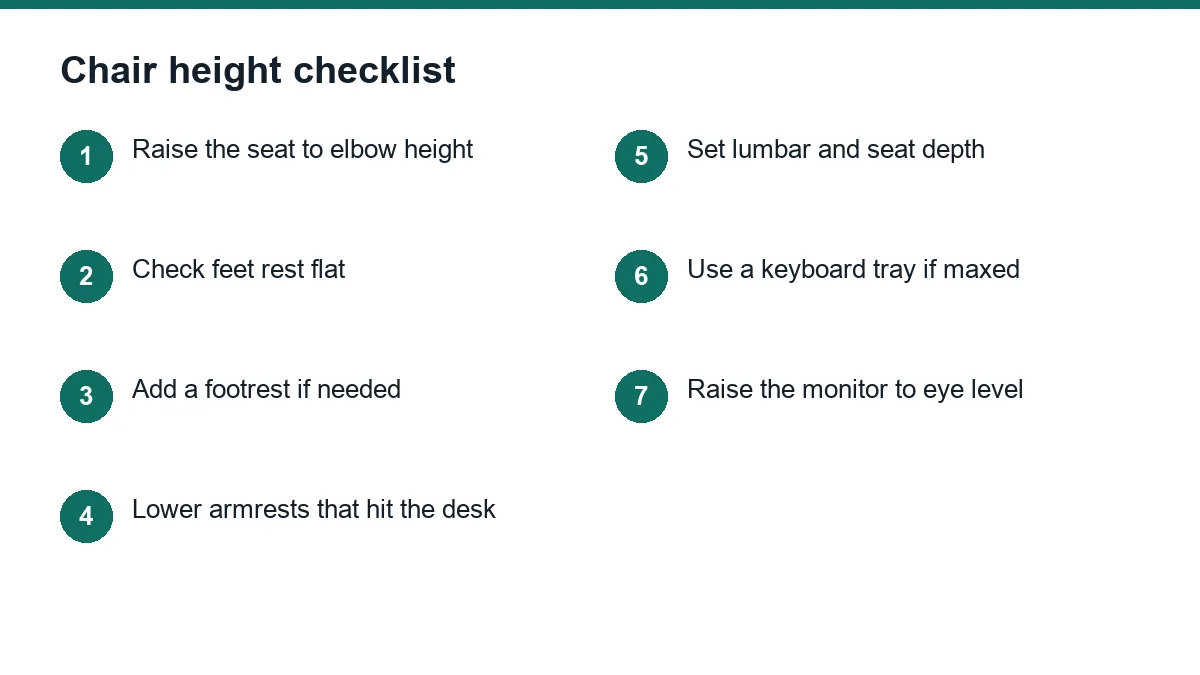
Step 1: Raise the seat
Stand up, lift the height lever, and let the seat rise. Sit down and check your elbows. Repeat until your forearms are level with the desk.
Step 2: Check your feet
Your soles should rest flat on the floor. If they dangle or only your toes touch, move to step 3.
Step 3: Add a footrest
Place a footrest so your whole foot is supported and your thighs sit roughly level. OSHA also notes a footrest can lift the knees slightly to ease pressure behind the legs.
Step 4: Adjust the armrests
Lower armrests that hit the desk edge, so you can pull in close. OSHA says armrests should let your shoulders relax and keep your elbows close to your body.
Step 5: Set the backrest and seat depth
Move the lumbar support into the small of your back. Leave a small gap between the seat edge and the back of your knees.
Step 6: If the chair maxes out, change the desk side
Use a keyboard tray to bring the keys lower. OSHA mentions cutting desk legs as an option when a surface is too high. A height-adjustable desk is the cleaner long-term fix.
Step 7: Recheck the monitor
Once you sit higher, the screen may now be too low. Raise it so the top of the screen sits near eye level.
Still not working? What to check next
- A sinking seat: if the chair rises but slowly drops, the gas cylinder is worn. See how to fix an office chair sinking slowly.
- A short cylinder: many makers sell taller cylinders. Check your model’s parts list before ordering.
- A chair that does not fit you: tall users may need a chair with a higher range and deeper seat. Our guide on how to choose an ergonomic office chair covers sizing.
- Leg room: OSHA says clearance under a desk should generally be 20 to 28 inches high.
For chair picks and setup advice, see the ergonomic office chair hub.
Common mistakes to avoid
- Setting the chair for your feet only: your arms end up too low and your shoulders rise. Set it for the desk first.
- Sitting on a stack of cushions: loose cushions slide and change your posture. Raise the seat or use a fitted cushion.
- Leaving feet dangling: it presses on the backs of your thighs. Add a footrest.
- Raising the chair but not the screen: you then bend your neck down. Recheck the monitor.
- Forcing a stuck lever: check the manual. A lever that does nothing may need a part.
- Opening or heating the gas cylinder: it is pressurized. Replace it only as the maker’s instructions describe.
Products for this job
From our buying guides and reviews. We have not tested these ourselves; check the specs and the reviews on Amazon before you buy.
 Steelcase Gesture
Frequently Asked Questions
Should my elbows be level with my desk?
Yes, as a starting point for most people, with relaxed shoulders and elbows bent to about a right angle. Your forearms should then sit level with the keyboard, so your wrists stay straight and your shoulders stay down.
What if my chair is at max height and still too low?
Fit a keyboard tray, lower the desk if it adjusts, or fit a taller cylinder from the chair maker. A firm, fitted seat cushion that will not slide can add a little height as a short-term fix.
Is it bad to sit with my feet off the floor?
Dangling feet press the seat edge into the backs of your thighs and can cut comfort over a long day. OSHA advises a footrest when you have to raise the chair to fit the desk.
How high should a desk be for typing?
There is no single right number, since it depends on your own height and your chair. Aim for a keyboard at about elbow height with relaxed shoulders, which a height-adjustable desk makes much easier to reach.